The World on Fire — March 2026
The Honest Observer
Independent Analysis · March 1, 2026 · Special Edition
War in the Middle East. A global accountability reckoning. A superpower’s soul on the line. What we know, what we suspect, and what it all means.
Analysis & CommentaryMarch 1, 2026Special Report
In the span of seventy-two hours, the world shifted on its axis. On February 28, 2026, the United States and Israel launched a coordinated military strike against Iran — killing Supreme Leader Ali Khamenei and dismantling much of the Islamic Republic’s senior leadership. Simultaneously, the long-suppressed Epstein files began their public release, producing the first major arrests of globally prominent figures. These two earthquakes arrived together, and the world is still reeling.
What follows is an attempt to separate what is probable from what is speculative — to make sense of a moment in history that future generations will study for decades.
Part One
Operation Epic Fury — What Actually Happened
The strike, codenamed “Roaring Lion” by Israel and “Operation Epic Fury” by the US Department of Defense, was described by Defense Secretary Pete Hegseth as “the most lethal, most complex, and most-precision aerial operation in history.” Whatever one’s political views, the sheer scale of what was executed in a single night is undeniable.
Khamenei — who had led the Islamic Republic since 1989 — is dead. Multiple IRGC commanders, Revolutionary Guard leadership, and senior political figures were killed in coordinated strikes. Iran’s air defense infrastructure was systematically destroyed before the main wave of strikes began.
“The window to act without facing a nuclear-armed Iran was closing. Iran was enriching uranium to near-weapons-grade levels. The proxy network — Hamas, Hezbollah, the Houthis — had been severely weakened. The calculus, from Israel’s perspective, was now or never.”— Strategic Assessment
What makes this moment particularly complex is what was happening simultaneously in diplomatic channels. Nuclear talks between the US and Iran had reportedly shown significant progress just days before the strike. Iran had allegedly agreed “never” to stockpile enriched uranium. Russia’s Dmitry Medvedev accused Washington of using those negotiations as a deliberate cover operation. Whether that is true or not, the allegation alone has profound implications for American diplomatic credibility worldwide.
“Why would any nation negotiate with the United States again if peace talks were used as cover for a military decapitation strike?”
The Iranian Response
Iran’s retaliation has been substantial and ongoing. The IRGC announced strikes against 27 bases hosting US troops across the Middle East, as well as Israeli military facilities. Missiles have struck or targeted Israel, the UAE, Qatar, Kuwait, Bahrain, Jordan, Saudi Arabia, Iraq, and Oman. Schools and universities across Dubai and Doha switched to remote operations. An Iranian submarine was intercepted and destroyed in the Strait of Hormuz — almost certainly attempting to mine the waterway or target US naval assets.
27US Bases Targeted by Iran
9+Countries Hit by Iranian Missiles
2US Carrier Groups in Region
1,500+Iranian Missiles Estimated Remaining
The saturation strategy Iran appears to be employing deserves serious attention. Military analysts have long warned about the tactic of firing waves of cheaper missiles to exhaust Iron Dome interceptor inventory, then deploying high-value precision or hypersonic missiles through depleted defenses. Each Iron Dome interceptor costs between $50,000 and $100,000. Each cheap Iranian missile costs a fraction of that. It is an economic and tactical war of attrition that sophisticated adversaries have studied carefully.
The Hypersonic Threat — What Analysts Mean by “Special Missiles”
Iran has claimed development of the Fattah hypersonic missile, reportedly capable of traveling at Mach 13-15. Unlike conventional ballistic missiles, true hypersonic weapons maneuver unpredictably during flight, making interception by current Israeli and US systems significantly more difficult. Russia’s use of similar technology in Ukraine demonstrated both the capability and the limits of existing missile defense architecture.
If Iran deploys hypersonic weapons successfully against Israeli population centers or — most critically — against US carrier groups, the entire strategic calculus of this conflict changes instantly.
The IRGC Power Vacuum
Perhaps the most dangerous development since the strikes is this: the Islamic Revolutionary Guard Corps has appointed its own new leadership before any Supreme Leader has been announced. The military wing of the Iranian state is moving to fill the power vacuum ahead of any religious or political authority. A headless regime run by its most radical military faction, operating on rage and ideology without civilian oversight, is the most dangerous version of this scenario.
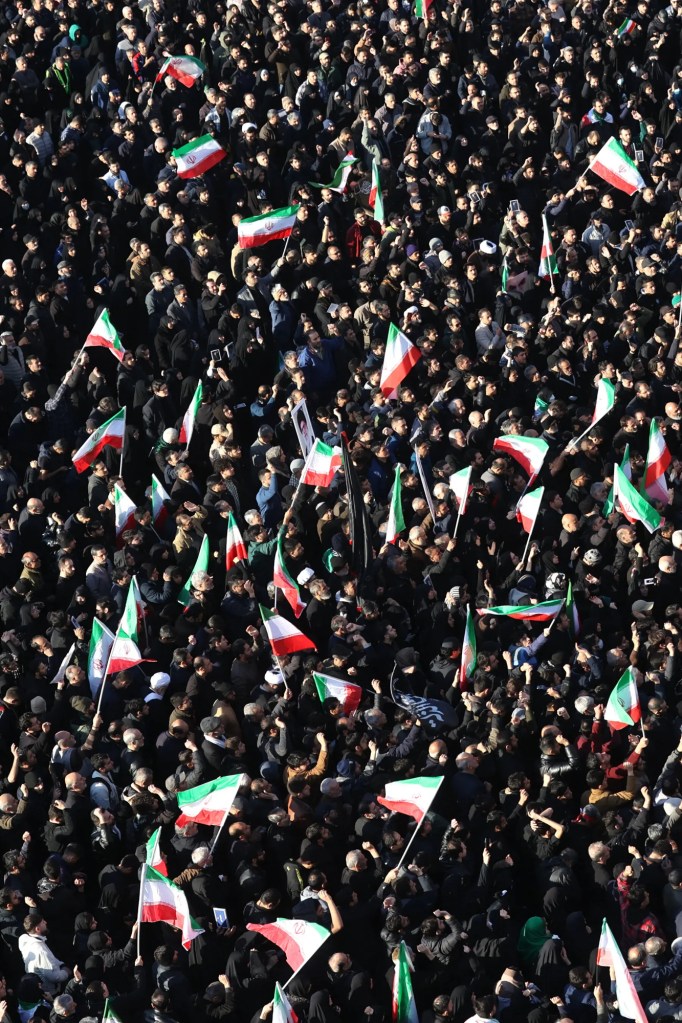
Approximately 70-75% of the Iranian population — young, educated, and largely secular — has expressed relief or even celebration on social media. The Islamic Republic has governed against its own population’s will for decades. The 2022 Mahsa Amini protests, the 2009 Green Movement, and massive demonstrations in late 2025 all pointed toward a population ready for change. Whether this military moment translates into genuine democratic transformation depends entirely on what happens inside Iran in the coming days.
The Critical Unknown
What happened to Iran’s nuclear material and expertise? A power vacuum inside a post-strike Iran, combined with loose nuclear material or knowledge, represents perhaps the single greatest danger emerging from this operation — one that is not receiving adequate public attention.
Part Two
The Reckoning — Epstein Files and Global Accountability
Simultaneously with the Iran strikes, the long-awaited Epstein files have begun their public release — and the arrests have started. The network that Jeffrey Epstein built between the 1990s and his 2019 death touched royalty, cabinet ministers, scientists, financiers, and heads of state across party lines and national borders.
What is now becoming clear is that Epstein’s operation was not simply a criminal blackmail enterprise run by one wealthy and well-connected predator. The sophistication of the network — its deliberate bipartisan and international structure, its cultivation of government officials across multiple countries, its apparent intelligence-gathering function — suggests something far more organized and purposeful.
“Andrew Mountbatten-Windsor — stripped of his royal title — has been arrested on suspicion of misconduct in public office, with emails appearing to show him forwarding confidential government trade reports to Epstein while serving as Britain’s trade envoy. Peter Mandelson, veteran Labour politician and former British Ambassador to Washington, was arrested days later on similar charges.”— Confirmed Reporting, February 2026
The pattern emerging from these arrests is specifically about information. Both Andrew and Mandelson are charged not merely with attending parties or personal misconduct, but with passing government intelligence. This reframes the entire Epstein operation. He was not just collecting leverage through compromising situations. He was apparently extracting and trafficking sensitive government information. The unanswered question — for whom, ultimately? — may be the most important investigation of this generation.
What the Files Apparently Show
No accusers or survivors have named Donald Trump as an abuser. Flight logs have not placed Trump on Epstein’s aircraft to the island. Trump’s own DOJ prosecuted Ghislaine Maxwell successfully. Bill Clinton’s connections remain the most extensively documented among American political figures.
What Remains Hidden
Significant redactions remain in released documents. Epstein was sophisticated about operational security. The real evidence likely lives in encrypted communications never recovered, financial records showing payments and NDAs, and physical evidence from his island properties.
The Epstein network was deliberately bipartisan and international — precisely to make it untouchable. That structure now looks less like opportunism and more like design. No clean partisan narrative emerges from the evidence. The network reached across Republican and Democrat, across British Conservative and Labour, across European royalty and American finance. That universality is itself the most important data point.
Part Three
Money, Power, and the Purchase of American Policy
The Iran strikes have reignited a debate that serious analysts across the political spectrum have wrestled with for decades: to what extent does Israeli lobbying — specifically through AIPAC — effectively purchase American foreign policy outcomes?
This is not a conspiracy theory. It is a documented, measurable, publicly observable phenomenon operating in broad daylight.
“AIPAC spent approximately $100 million in the 2024 election cycle — making it one of the single largest political spending operations in American electoral history. Congressional votes on Israel routinely pass with margins of 95-5 or 98-2. That unanimity does not reflect American public opinion, which polling consistently shows is far more divided.”— Campaign Finance Analysis
The mechanism is straightforward and not subtle. Candidates who support Israeli policy receive substantial financial backing. Candidates who express criticism face well-funded primary challengers. Every member of Congress understands this calculus without it needing to be stated. The result is a systematic gap between what Americans actually believe about the Israeli-Palestinian conflict and how their elected representatives vote on it.
Several Iran experts have noted publicly that this operation benefits Israel more directly than it benefits the United States. “This is another Israeli war that the US is launching,” one told Al Jazeera. “Israel has pushed the US to attack Iran for two decades, and they finally got it.” Whether that characterization is entirely fair, the underlying question it raises — whose interests are primarily being served — is a legitimate one that American citizens deserve to examine honestly.
“The most subversive thing about it is that it’s all legal. That’s the part that should genuinely disturb every American.”
The solution, if there is one, is public campaign financing. Almost every problem described here — not just AIPAC but all lobbying influence over foreign policy — traces back to the fundamental corruption introduced when political campaigns require enormous private money to run. Without that structural reform, everything else is tinkering at the margins.
Part Four
A Nation Divided in a Moment Requiring Unity
The American public’s response to the Iran strikes has divided almost entirely along partisan lines — and that is, without exaggeration, a genuine national security problem. Iran’s leadership, even in chaos, watches American domestic politics closely. The calculation that American political division might limit US response or create withdrawal pressure has influenced Iranian decision-making for decades.
Democratic criticism of the operation — with the notable exception of Senator John Fetterman, who has consistently broken with his party on matters involving Israel — has been immediate and pointed. Some of that criticism represents legitimate constitutional concern: Congress was not consulted before a military operation that has now drawn the United States into active combat with a regional power while simultaneously exposing American bases across nine countries to missile attack.
But there is a meaningful difference between legitimate oversight and opportunistic political attack during active combat. History judges harshly those who prioritized partisan advantage during genuine national security crises. The question of congressional authorization is important and should be raised — but the timing and framing of how it is raised matters enormously.
The Information Environment Problem
The Iran strikes and Epstein file releases arriving simultaneously has created a fractured information environment in which neither story receives the sustained public focus it deserves. Whether this timing was coincidental or deliberate is unknown. What is certain is that the effect — reduced scrutiny of both stories — benefits powerful people connected to each of them, regardless of intent.
Conclusion
What Comes Next — An Honest Assessment
History pivots on moments like this one. The next seventy-two hours are probably the most consequential since the immediate aftermath of September 11, 2001.
Two outcomes are possible and the distance between them could not be greater. If the Iranian regime collapses internally, if the Iranian people seize this moment, if a more moderate successor government emerges — this could be remembered as a decisive turning point that ultimately stabilized the most volatile region on earth. An Iran without a theocratic revolutionary regime changes everything: Hamas loses its primary backer, Hezbollah withers without resupply, the Houthis collapse, the entire architecture of Iranian-funded regional destabilization unravels.
If the IRGC consolidates around revenge, if a new Supreme Leader is chosen who is more radical than Khamenei, if hypersonic missiles reach a US carrier or Israeli population center, if the Strait of Hormuz is effectively closed — the world just entered a period of danger not seen since the Cold War’s most acute moments.
The Epstein reckoning, meanwhile, has only just begun. The arrests of Andrew Windsor and Peter Mandelson are significant but almost certainly not the end. The question of who Epstein was ultimately gathering intelligence for — and whether any government intelligence service was aware of or complicit in his operation — could produce revelations that dwarf everything seen so far.
And undergirding all of it is the oldest question in democratic theory: who actually governs? When lobbying money shapes foreign policy, when congressional votes don’t reflect public opinion, when redacted files protect powerful people from accountability — the answer to that question becomes genuinely uncertain.
“The world is not run by the people you elect. It is run by the intersection of money, leverage, and information. What we are watching right now — in real time — is that intersection being exposed, challenged, and in some cases, dismantled. Where it leads depends on whether citizens demand accountability or accept distraction.”— Editorial Assessment, March 1, 2026
We are living through history. Pay attention.
The Honest Observer · Independent Analysis · March 2026 · All assessments represent informed analysis, not established fact where noted
 Arklahoma Sports