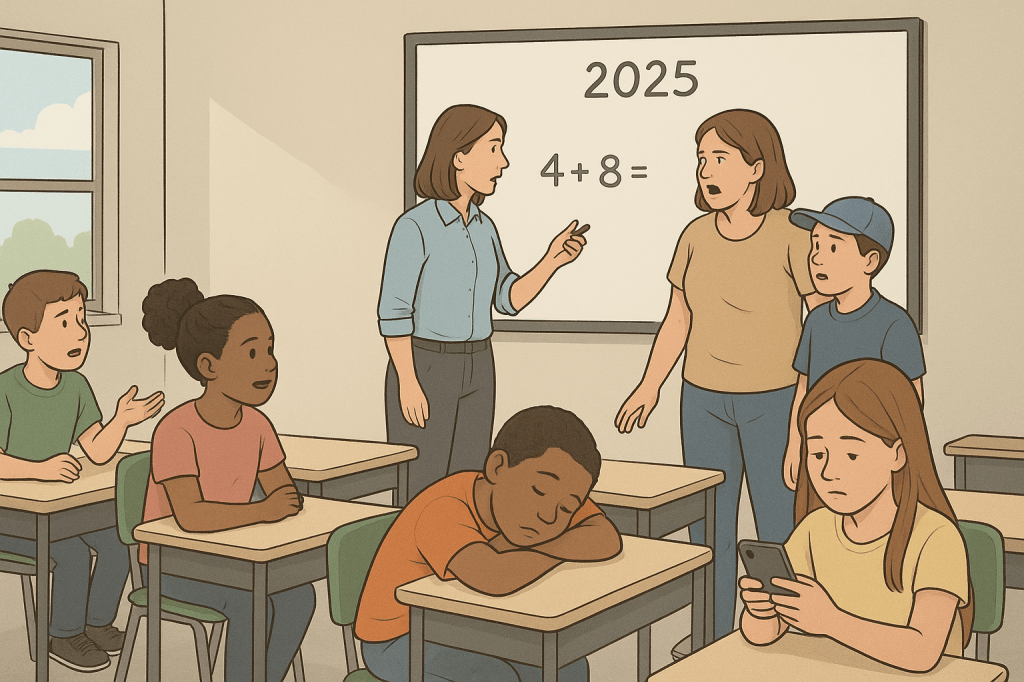
In the past decade, American education has undergone a troubling transformation – from a system once celebrated for steady progress to one mired in stagnation and decline. As Idrees Kahloon poignantly argues in his recent piece for The Atlantic, this era may go down as one of the worst in the history of U.S. schooling, marked by a reversal of gains in math and reading that began stalling around 2013. Jonathan Haidt, the social psychologist known for his work on youth mental health, complements this view by highlighting how smartphones and social media have exacerbated the problem, turning classrooms into battlegrounds for attention. But the issues run deeper, encompassing socioeconomic divides, overemphasis on testing, chronic absenteeism, and a cultural reluctance to enforce rigorous expectations. Drawing on recent studies and expert analyses, this article explores what went wrong and why a multifaceted approach is needed to reverse the trend.
The Stark Evidence of Decline
The numbers paint a grim picture. The 2024 National Assessment of Educational Progress (NAEP) results, often dubbed the “Nation’s Report Card,” reveal historic lows in key subjects. For instance, 12th-grade math and reading scores for the class of 2024 showed major declines, with nearly half of high school seniors performing below basic levels in both areas – the worst since assessments began tracking these metrics. Eighth-grade science scores also dropped, continuing a pattern that predates the pandemic. Reading proficiency has been hit hardest: 33% of eighth graders and 40% of fourth graders scored below basic, levels not seen since the early 1990s and 2000, respectively. ACT scores echoed this, hitting a 34-year low average of 19.4 in 2024.
These trends aren’t isolated; they’re systemic. The 2025 NAEP updates further underscore the issue, with fourth- and eighth-grade reading scores falling two points from 2022, fueled by struggles among lower-performing students. Gaps between high- and low-achievers have widened, particularly in math, where top performers gained ground while the bottom quartile stagnated or regressed. As Education Secretary Linda McMahon noted in response to the September 2025 release, “American students are testing at historic lows across all of K-12.” International comparisons, like the 2022 PISA results analyzed in 2024-2025, place U.S. 15-year-olds 34th in math globally, down from 28th a decade earlier.
The Role of Declining Standards and Low Expectations
At the heart of this crisis, as Kahloon asserts, is a “pervasive refusal to hold children to high standards.” This cultural shift – away from rigor toward an “everyone gets a prize” mentality – has eroded accountability. Conservative perspectives often frame this as a consequence of centralized bureaucratic control, where federal and state overreach stifles local innovation and enforces lax policies to avoid tough decisions like retaining failing students. Reports from organizations like the American Enterprise Institute highlight how a decades-long focus on unattainable proficiency goals under No Child Left Behind masked the growing number of students below basic levels. By 2024, this has resulted in a “five-alarm fire,” with low expectations allowing foundational skills to atrophy.
Progressive views counter that low standards stem from underinvestment and inequity, not leniency. The Center for American Progress advocates for a holistic vision emphasizing early childhood education and teacher support to address root causes like poverty. Yet even here, there’s acknowledgment that progressive reforms, such as decentralized curricula, can sometimes dilute rigor if not balanced with accountability. On platforms like X, educators and parents echo this, noting how “no consequences for poor performance” fosters disengagement.
Smartphones and the Distraction Epidemic
Haidt’s analysis adds a critical layer: the rise of smartphones around 2013 coincides eerily with the stall in educational progress. Adoption jumped from 23% of teens in 2011 to 95% by 2018, hijacking attention spans and contributing to mental health crises that spill into classrooms. In his Atlantic articles and book The Anxious Generation, Haidt calls for phone-free schools, arguing devices impede learning, stunt relationships, and increase loneliness. NAEP surveys support this, showing lower confidence in subjects like science among distracted students. X discussions amplify the point, with users blaming phones for Gen Z’s “goldfish-like” attention spans and plummeting test scores.
While conservatives see this as part of a broader cultural decay, progressives link it to unregulated tech exacerbating inequalities – kids in under-resourced homes suffer most from screen addiction without parental oversight.
Broader Systemic Factors Fueling the Slide
Beyond standards and screens, other forces compound the decline. Socioeconomic gaps are glaring: Low-income students enter kindergarten 1.5 years behind in skills, a disparity that snowballs due to unequal access to enrichment. The pandemic accelerated this, with remote learning widening divides via internet access issues. Chronic absenteeism, now at 25-30% in some districts, correlates directly with score drops.
Over-reliance on standardized testing has narrowed curricula to drills, sidelining critical thinking and arts – leading to disengagement. Teacher burnout and funding shortfalls in red and blue states alike result in larger classes and high turnover. Some politically incorrect claims, substantiated by data, point to demographic shifts: Immigration and cultural disconnects may contribute, as non-native students sometimes lack ties to U.S. history, dragging averages down. Progressive critiques blame conservative attacks on public funding, while conservatives decry “woke” priorities over basics. Mental health issues, rising since 2010, further erode focus.
Toward Solutions: Raising the Bar and Addressing Roots
The lost decade has left American students ill-prepared for the future – 60% of adults functionally illiterate at below sixth-grade levels, innovation driven by just 3 million high-achievers. Reversing this requires bold action: Enforce higher standards with real accountability, ban phones in schools as Haidt urges, invest equitably in early education, and reform testing to foster deeper learning. As Kahloon warns, overlooking low expectations in favor of easy excuses like COVID will only deepen the slide. For a nation built on ingenuity, reclaiming educational excellence isn’t optional – it’s essential.
Endnotes
- Kahloon, Idrees. “America Is Sliding Toward Illiteracy: Declining Standards and Low Expectations Are Destroying American Education.” The New Yorker, 2025.
- Haidt, Jonathan. “The Anxious Generation: How the Great Rewiring of Childhood Is Causing an Epidemic of Mental Illness.” The Atlantic (and related articles), 2024-2025.
- National Assessment of Educational Progress (NAEP). “2024 Nation’s Report Card: Long-Term Trend Assessment Results.” U.S. Department of Education, 2024.
- NAEP. “2022 Long-Term Trend Assessment: Reading and Mathematics Scores Decline.” U.S. Department of Education, 2022.
- Education Next. “The Achievement Gap in Reading: Why Low Expectations Hurt Students.” 2025.
- Education Week. “NAEP Scores Show Persistent Reading Declines, Especially for Struggling Students.” 2025.
- Annenberg Institute. “Why Are Reading Scores Still Falling? A Working Paper on Post-Pandemic Recovery.” Brown University, May 2025.
- Show Me Institute. “Podcast: Jim Wyckoff on NAEP Declines and Teacher Turnover.” 2025.
- Elevate K-12. “Teacher Shortages and Underfunding: Impacts on Student Outcomes.” 2025.
- Reddit. “r/Teachers Discussion: Lack of Accountability in K-12 Education.” 2025.
- Times of India. “America’s Education Crisis: Beyond the Pandemic Excuse.” 2025.
- Economic Policy Institute. “Unequal Starts: How Socioeconomic Gaps Impact Early Education.” 2024.
- Medium. “The Testing Trap: How Standardized Tests Are Failing American Students.” 2025.
- Harvard Center for Education Policy Research. “Lost Foundations: Why Students Are Falling Behind.” 2024.
- NAEP. “2024 Science Assessment: Eighth-Grade Declines and Student Confidence.” U.S. Department of Education, 2024.
- American Enterprise Institute. “No Child Left Behind’s Legacy: A Focus on Proficiency Over Growth.” 2024.
- Urban Institute. “Chronic Absenteeism and Its Impact on Academic Performance.” 2024.
- National Center for Biotechnology Information (NCBI). “COVID-19 and Educational Inequalities: Long-Term Impacts.” 2022.
- Programme for International Student Assessment (PISA). “2022 Results: U.S. Rankings in Math and Reading.” OECD, analyzed 2024-2025.
- NAEP. “2025 Update: Fourth- and Eighth-Grade Reading Scores.” U.S. Department of Education, 2025.
- Economic Policy Institute. “The Kindergarten Gap: Socioeconomic Disparities in Early Skills.” 2025.
- U.S. Department of Education. “Statement by Secretary Linda McMahon on 2024 NAEP Results.” September 2025.
- Center for American Progress. “Investing in Equity: A Progressive Vision for Education Reform.” 2025.
- American Experiment. “Underfunding and Low Achievers: The Math and Reading Crisis.” 2025.
- Center for American Progress. “Holistic Education Reform: Addressing Poverty and Standards.” 2025.
- Education Week. “Progressive Reforms and the Risk of Diluted Standards.” 2025.
- Forbes. “Mental Health and Screen Time: The Hidden Costs for Students.” 2024.
- Quora. “Centralized Education Policies and Declining Standards: Expert Takes.” 2023-2025.
- Medium. “The Standardized Testing Trap: Narrowing the Curriculum.” 2025.
- X Platform. “Educator and Parent Discussions on Low Expectations in Schools.” 2025.
- American Enterprise Institute. “Demographic Shifts and Educational Outcomes: A Data-Driven Look.” 2024.
- Haidt, Jonathan. The Anxious Generation. Penguin Press, 2024.
- X Platform. “User Discussions on Smartphones and Declining Test Scores.” 2025.
- National Center for Education Statistics. “Functional Illiteracy in the U.S.: Long-Term Trends.” 2024.
 Arklahoma Sports